GEOTECHNICAL ENGINEERING1
BLENHEIM
HomeLaboratoryLaboratory CBR test

Laboratory CBR Testing in Blenheim: Subgrade Strength for Pavement Design

Knowledgeable. Thorough. Resourceful.

LEARN MORE

The subgrade beneath a new warehouse in Riverlands Industrial Estate behaves completely differently to the Wither Hills silts up on Maxwell Road. On the plain you are dealing with recent alluvial deposits—sandy silts and soft clays that lose significant strength when saturated. Up on the terraces the weathered loess can stand up well in a cutting but still needs a soaked CBR to confirm its resilience under wet conditions. We run laboratory CBR tests in Blenheim on remoulded and undisturbed samples so the pavement engineer gets a design value that reflects the actual moisture sensitivity of the material, not a generic number pulled from a table. The NZS 4402:2016 procedures are non‑negotiable in our lab—four‑day soak, surcharge weights matching the design pavement depth, and a penetration rate of 1.27 mm per minute—because shortcuts here translate into rutting and edge‑break within two summers. For projects where fill is being imported, we often pair the CBR with a Proctor compaction test to verify that the specified density is achievable with local borrow, and when the pavement structural number needs refinement we combine soaked CBR with grain‑size analysis to confirm the drainage characteristics of the subgrade.

A Wairau silt can lose half its bearing strength after four days of soaking—if your pavement design uses an unsoaked CBR, you are designing for a condition that never exists after the first winter.
Our service areas

How we work

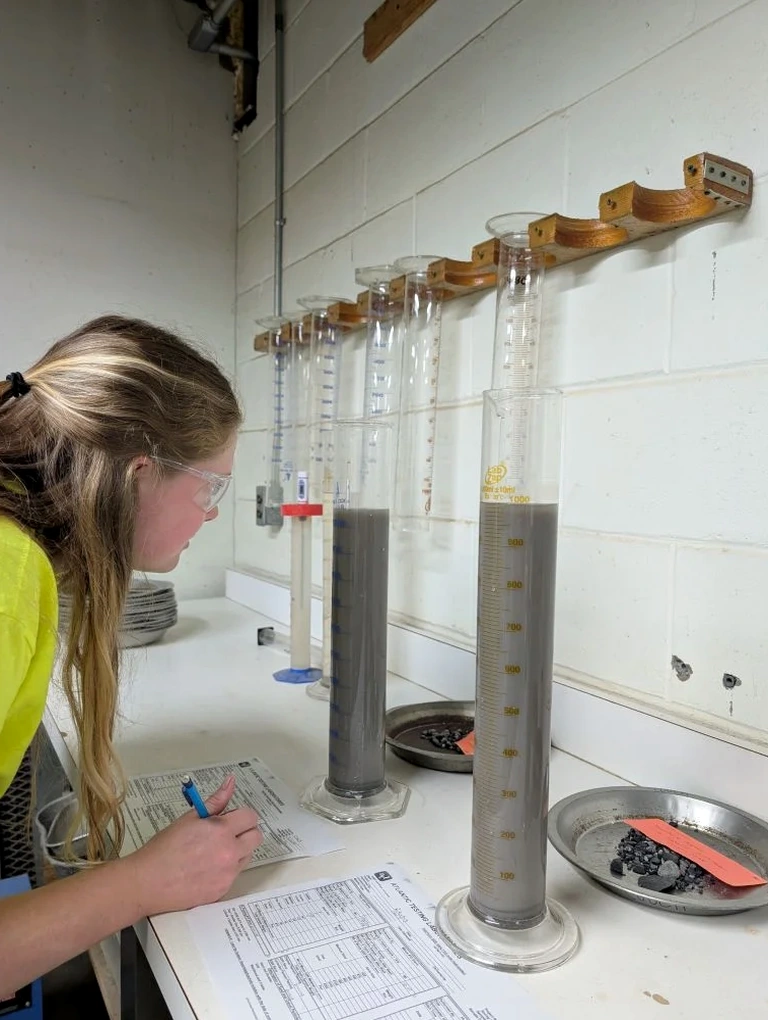
The CBR frame in our Blenheim laboratory sits on a calibrated 50 kN load ring, but the detail that matters most is the surcharge assembly. We cast annular weights to mimic the overburden stress of the design pavement—typically 4.5 kg for light‑duty carparks and up to 9 kg for arterial road structures—because the soaked CBR of a Wairau silt can drop by forty percent when the surcharge is wrong. Samples are compacted at optimum moisture content using a modified Proctor hammer, then submerged for 96 hours with a dial gauge tracking swell every twenty‑four hours. The penetration piston is driven at the standard rate while a digital data logger records load versus penetration at 0.635 mm intervals, giving us a smooth curve to pick off CBR at 2.5 and 5.0 mm. For cohesive materials we also run an unsoaked CBR to quantify the strength loss on saturation, which is often the key input when the Blenheim council drainage review asks for a sensitivity analysis on the pavement life. In the Marlborough context, where summer irrigation raises the groundwater table under many industrial subdivisions, that soak cycle is not an academic exercise—it is the test that separates a pavement that lasts from one that fails.
Laboratory CBR Testing in Blenheim: Subgrade Strength for Pavement Design
Technical reference — Blenheim

Local considerations

The dry Marlborough climate creates a false sense of security. A subgrade sampled in February at natural moisture content can show a CBR of twelve percent, but come July with the water table sitting half a metre below finished grade that same material tests at four percent. That gap between summer and winter strength is the single biggest cause of pavement under‑design in Blenheim, particularly on the Spring Creek and Grovetown side where the soils are fine‑grained alluvium with poor drainage. Skipping the soaked CBR—or running it without the correct surcharge—produces an over‑optimistic design value that leads to deformation in the wheel paths within the first two years of service. The NZ Transport Agency Waka Kotahi supplement to the NZS 4402 explicitly requires a soaked CBR for any subgrade with a Plasticity Index above twelve, which covers most of the Wairau Plain. We have also seen issues on industrial sites where imported granular fill was accepted on the basis of a sieve analysis alone, without a laboratory CBR to confirm the compacted strength under saturated conditions—the result was a heavily rutted truck standing area that needed a costly mid‑life overlay.

Need a geotechnical assessment?

Reply within 24h.

Email: contact@geotechnical-engineering1.co

Applicable standards

NZS 4402:2016 – Methods of testing soils for civil engineering purposes (Tests 6.1 and 6.2), NZ Transport Agency Waka Kotahi Pavement Design Supplement (current edition), NZS 4404:2010 – Community wastewater and land development, NZS 4402 – Standard Test Method for California Bearing Ratio (CBR) of Laboratory-Compacted Soils (used for international reference where specified)

Technical data

ParameterTypical value
Test standardNZS 4402:2016 Test 6.1 (soaked) and 6.2 (unsoaked)
Penetration rate1.27 mm/min ± 0.02 mm/min
Soak duration96 hours (4 days) at full submersion
Surcharge weight4.5 kg to 9.0 kg, matched to design pavement depth
Compactive effortModified Proctor (4.5 kg rammer, 450 mm drop, 5 layers)
Swell measurementDial gauge reading every 24 h during soak; swell > 2% flagged
Load measurementCalibrated 50 kN load ring with digital acquisition
Specimen diameter152 mm (CBR mould), height 178 mm compacted
ReportingCBR at 2.5 mm and 5.0 mm, corrected for concavity if needed

Quick answers

What does a laboratory CBR test cost in Blenheim?
How many CBR test points do I need for a subdivision in Blenheim?

We follow the NZTA guideline of one CBR test per material type per 500 m³ of subgrade, with a minimum of three points per distinct soil unit. On a typical Blenheim subdivision where you have two or three soil types—say, Wairau silts, river terrace gravels, and imported fill—you would be looking at six to nine CBR points to get a statistically meaningful design value. If the subgrade variability is high, we recommend running enough points to calculate a 10th‑percentile design CBR rather than using the mean, because the pavement performance is governed by the weakest sections.

Why do you soak the sample for four days?

The 96‑hour soak specified in NZS 4402 simulates the worst‑case saturated condition the subgrade will experience over the pavement life. In Blenheim the water table under the Wairau Plain rises significantly during winter and under irrigation, and a subgrade that tests at twelve percent CBR dry can drop to four percent after soaking. If you design with the dry value you are underestimating the pavement thickness by a large margin—the soaked CBR is the number that governs rutting resistance and long‑term serviceability. The four‑day duration is standardised across New Zealand and internationally to achieve near‑complete saturation for most soil types.

Can you test imported granular fill for CBR as well?

Yes, we run CBR on imported granular materials—M/4 AP40, AP65, and similar—compacted at the specified field density. This is particularly relevant in Blenheim where subdivisions on the plain often require a capping layer over soft alluvium. We test the granular material both at its as‑placed moisture and after soaking to confirm that the strength does not collapse when the layer becomes saturated. The results feed directly into the pavement structural number calculation and help the engineer decide whether a stabilised sub‑base is justified.

Location and service area

We serve projects across Blenheim and surrounding areas.

View larger map