GEOTECHNICAL ENGINEERING1
BLENHEIM
HomeGround improvementStone column design

Stone Column Design for Liquefaction-Prone Ground in Blenheim

Knowledgeable. Thorough. Resourceful.

LEARN MORE

NZS 3404 and the NZGS Module 5 guidelines set the framework for ground improvement in New Zealand, but applying them in Blenheim demands a specific understanding of the Wairau Plain. The loose alluvial silts and fine sands deposited over millennia create a profile where static settlement and cyclic liquefaction are both credible concerns. Most commercial and viticulture-related structures around Blenheim sit within 3 km of the active Wairau Fault, so a conventional footing rarely meets performance expectations without some form of treatment. A liquefaction assessment quantifies the residual strength of the interbedded layers, and when the factor of safety drops below 1.2, stone column design becomes the logical path to densify the matrix, install drainage paths, and transfer load past the weakest silts. The team works with NZS 1170.5 spectral demands and site-specific borehole data to set column diameter, spacing, and depth—normally between 6 and 14 metres in the Blenheim basin.

Thirteen metres of interbedded silt and sand with groundwater at 1.5 metres: that is the standard Blenheim profile where stone columns earn their place on the design register.
Our service areas

How we work

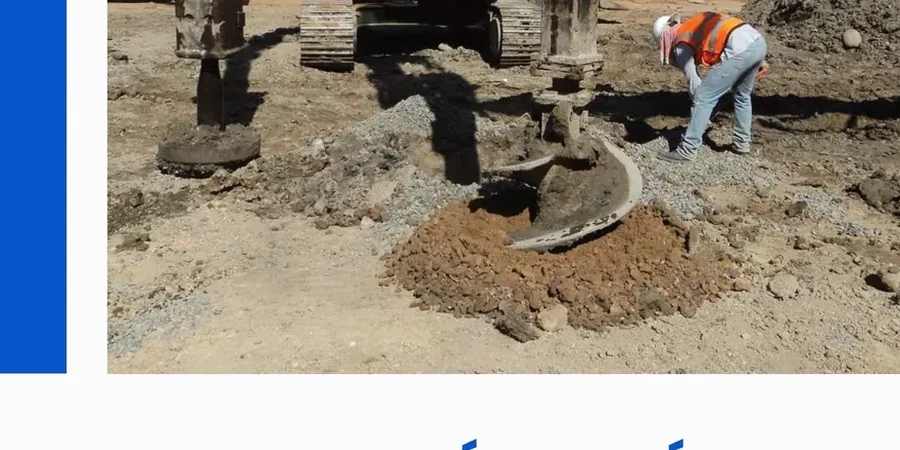
The Wairau Valley is dry and sunny for long stretches, but the water table across Blenheim sits persistently high—often within 1.5 metres of the surface—fed by the Wairau Aquifer and seasonal irrigation returns. That contrast reshapes execution planning. Wet, uncemented sands collapse easily during vibro-displacement, so the installation method must be tuned to maintain hole stability without excessive air flush that could fluidise the surrounding matrix. We specify bottom-feed vibrators when the fines content exceeds 15 percent, which is common in the silty bands encountered near the Taylor River. Where the deposit is cleaner, top-feed methods with graded stone achieve faster densification. The design links directly to the in-situ permeability profile because column drainage effectiveness depends on the contrast between the installed stone and the native silt conductivity. A quality control programme built around modulus load tests and post-installation CPTs verifies that the target relative density—typically 70 to 85 percent—has been reached through the treated zone.
Stone Column Design for Liquefaction-Prone Ground in Blenheim
Technical reference — Blenheim

Local considerations

Blenheim’s expansion since the 1960s has pushed light industrial sheds and housing onto land that was once swampy pasture or seasonal wetland, and the geotechnical legacy of those decisions shows up in differential settlement claims and tilted floor slabs. The 1848 Marlborough earthquake and more recently the 2016 Kaikōura sequence reminded the region that a magnitude 7-plus event on the Wairau Fault is a planning reality, not a hypothetical. Stone column design here has to handle two distinct failure mechanisms: volumetric settlement during shaking and post-earthquake reconsolidation as excess pore pressures dissipate. When columns are designed as rigid inclusions with load-transfer platforms, the analysis connects directly to the mat foundations performance criteria, allowing the designer to decouple the slab from the variable subgrade and limit angular distortion to 1/500 or better. In the eastern industrial zone, where compressible peat lenses appear below 4 metres, columns are extended to firm gravel and modelled as end-bearing elements.

Need a geotechnical assessment?

Reply within 24h.

Email: contact@geotechnical-engineering1.co

Applicable standards

NZS 3404: Parts 1 and 2 (Steel Structures – applicable to load-transfer platform design), NZS 1170.5:2004 (Structural design actions – Earthquake actions, Blenheim Z=0.30), NZGS Module 5: Ground Improvement (Guideline for stone column design and verification), NZS 4402/D6913M-17 (Particle-size distribution for stone gradation control)

Technical data

ParameterTypical value
Column diameter range600 - 1000 mm
Typical depth in Wairau Plain6 - 14 m
Area replacement ratio10 - 30 %
Target post-treatment SPT N-value15 - 25
Design ground acceleration (Z hazard factor)0.30 (Blenheim, NZS 1170.5)
Stone gradation (nominal)40 - 75 mm clean aggregate

Quick answers

How much does a stone column design scope cost for a typical Blenheim site?
Which ground conditions in Blenheim make stone columns the right choice over other techniques?

Stone columns perform well where loose sands and soft silts alternate within the top 10 to 15 metres and the water table is high—exactly the profile across much of Blenheim. They become less suitable if continuous peat layers thicker than 1 metre are present, or if the undrained shear strength of the softest layer drops below 15 kPa. In those cases we consider alternative ground improvement or deep foundations.

How do you verify that the installed columns actually reduce liquefaction risk?

We run pre- and post-installation CPT soundings at inter-column locations and compare the cone tip resistance profiles. An increase of 50 to 100 percent in the treated zone is a typical acceptance criterion. Additional modulus load tests on individual columns, combined with shear-wave velocity measurements, confirm that the drainage and densification objectives have been met before the structural foundation is cast.

What is the design life of a stone column foundation system in the Wairau Plain environment?

The stone aggregate is chemically stable in the Wairau groundwater, which is calcium-bicarbonate type with low sulphate content, so degradation of the column material is negligible. Provided the load-transfer platform is correctly graded and maintained, the system is designed for a 50-year service life consistent with NZS 1170.0, with no loss of drainage function over that period.

Location and service area

We serve projects across Blenheim and surrounding areas.

View larger map