GEOTECHNICAL ENGINEERING1
BLENHEIM
HomeInvestigationSPT (Standard Penetration Test)

SPT Testing in Blenheim – Standard Penetration Test for Subsurface Characterisation

Knowledgeable. Thorough. Resourceful.

LEARN MORE

Blenheim's growth from a small river settlement to Marlborough's main urban centre has always been tied to the gravels and silts beneath it. The Wairau River built this plain over millennia, depositing layered alluvium that now supports everything from vineyards to multi-storey structures on Seymour Street. That same depositional history also means the ground can shift from dense gravels to loose silty sands in less than 20 metres horizontally. A CPT test picks up those transitions with near-continuous profiling, but when contractors and geotechnical engineers need a direct look at soil resistance and a disturbed sample in hand, the Standard Penetration Test remains the practical standard across Blenheim. The local water table sits high across much of the plain—often within 2 metres of the surface—so understanding how saturated fine sands behave under load is not optional. We run SPT rigs across Marlborough from Riverlands to Springlands, correlating N-values with the NZGS soil classification system so that foundation recommendations actually reflect what the ground will do, not just what a borelog says on paper.

An N-value shift from 8 to 28 across a single metre in Blenheim alluvium changes the entire foundation strategy—from deep piles to a stiffened raft.
Our service areas

How we work

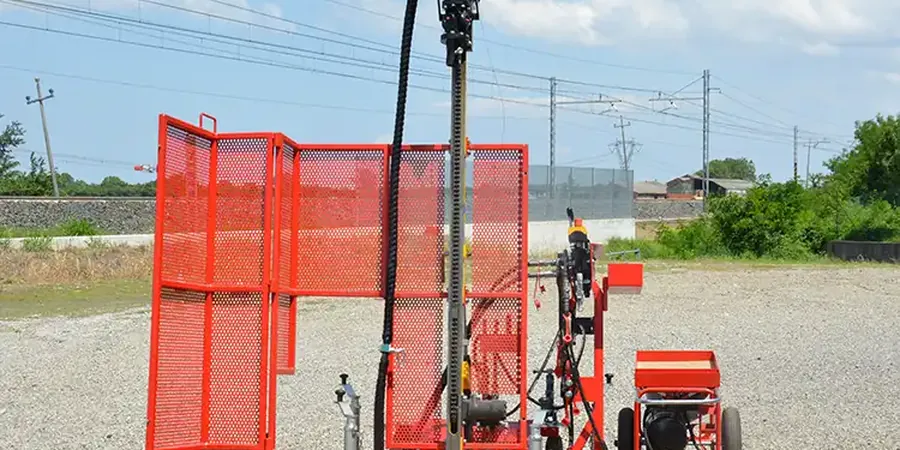
NZS 3404 and the NZGS guidelines provide the framework, but in Blenheim the test's value comes from how it handles the region's specific stratigraphy. The Wairau Plain contains interfingered lenses of gravel, sand, and silt that make simplified site classification risky. The SPT procedure—driving a split spoon sampler 450 mm with a 63.5 kg hammer falling 760 mm—gives an N-value that directly indexes relative density in sands and consistency in cohesive layers. We record blows per 150 mm increment, so engineers can spot a thin soft layer that a single-number summary might hide. In Blenheim's post-liquefaction assessment environment, those distinctions matter: a sand lens at 4 metres depth with N1,60 below 15 triggers different mitigation than the same blowcount at 9 metres. For sites near the Taylor River or along Old Renwick Road where gravels dominate, refusal above 50 blows often occurs within the first few metres, signalling dense material suitable for shallow footings. Our lab can pair SPT samples with a grain size distribution analysis to confirm whether that refusal layer is well-graded gravel or just a cobble obstruction. And for deeper investigation where SPT refusal stops the test, we complement with MASW to profile shear wave velocity through the full soil column.
SPT Testing in Blenheim – Standard Penetration Test for Subsurface Characterisation
Technical reference — Blenheim

Local considerations

The Wairau Plain's combination of high seasonal groundwater and loose Holocene sands creates a liquefaction risk profile that shapes every geotechnical investigation in Blenheim. After the Kaikōura earthquake sequence, even sites previously classed as low-risk were re-evaluated because the shaking duration and proximity to the Wairau Fault caught engineers off guard. SPT N-values form the backbone of the simplified liquefaction triggering procedure: clean sand equivalent corrections, fines content adjustments, and magnitude scaling factors all feed from those blowcounts. A site near Redwoodtown with N1,60cs values of 12 to 14 at 3.5 metres depth sits right on the threshold where excess pore pressure could accumulate during a design-level event. That means the difference between a conventional footing and ground improvement via stone columns or densification comes down to a few hammer blows. The high gravel content in some Blenheim profiles also introduces refusal bias—when the spoon hits gravel at 6 metres and stops, but loose sand sits directly below, the test overestimates overall site stiffness. Interpreting refusal correctly and knowing when to switch to alternative methods is what separates a reliable investigation from a misleading one.

Need a geotechnical assessment?

Reply within 24h.

Email: contact@geotechnical-engineering1.co

Video resource

Applicable standards

NZS 3404:1997 – Steel Structures Standard (foundation design provisions), NZS 4203:1992 – General Structural Design and Design Loadings for Buildings, NZGS Guideline for SPT-Based Liquefaction Assessment (2016), NZS 4402 – Standard Test Method for Standard Penetration Test (SPT) and Split-Barrel Sampling of Soils, NCEER/Youd & Idriss (2001) – Liquefaction Resistance of Soils: Summary Report

Technical data

ParameterTypical value
Hammer typeAutomatic trip hammer, 63.5 kg mass; energy ratio calibrated per NZS 4402
Drop height760 mm ± 10 mm
SamplerStandard split spoon, 50 mm OD, 35 mm ID, 600 mm length
N-value recordingBlows per 150 mm increment; N = sum of 2nd + 3rd increments
Energy correction (N60)Rod length, hammer type, and borehole diameter corrections applied per NZGS (2016) guidelines
Depth range typical1.5 m to 30 m, extended with casing through cobbly layers common in Blenheim
Sample recoveryDisturbed sample for visual logging and index testing; recovery ratio recorded per run
Reporting standardNZS 3404:1997, NZGS Guideline for SPT-Based Liquefaction Assessment, Youd & Idriss (2001) framework

Quick answers

How much does an SPT borehole cost in Blenheim?
What depth do SPT boreholes reach in Blenheim soils?

Most residential and light commercial investigations target 6 to 15 metres, which covers the critical upper alluvial layers where liquefaction and settlement risk concentrate. For larger structures or sites near the Wairau Fault, we extend to 20-30 metres. The actual depth depends on refusal conditions—gravel-rich layers in parts of Springlands and Redwoodtown can stop the spoon sampler above 6 metres, at which point we evaluate whether a deeper investigation method is warranted.

Is SPT testing suitable for liquefaction assessment in Blenheim?

SPT is the most widely used field test for liquefaction assessment in New Zealand and forms the basis of the NZGS 2016 guideline. The N-value provides a direct input to the simplified triggering procedure. In Blenheim's alluvial sands, SPT data can reliably identify layers susceptible to cyclic softening when the groundwater is high. We apply energy corrections to convert raw N-values to N60 and then to clean-sand-equivalent N1,60cs, the parameter used in the industry-standard Youd and Idriss (2001) triggering curves.

How long does an SPT investigation take on site?

A single borehole to 10 metres depth on a standard Blenheim residential section typically takes half a day including rig setup, drilling, sampling, and reinstatement. Multiple boreholes or deeper profiles extend the programme. We schedule work around Marlborough's seasonal conditions—autumn and early summer usually offer the most reliable weather windows for drilling on the Wairau Plain.

Location and service area

We serve projects across Blenheim and surrounding areas.

View larger map